 contact@arkeotopia.org


Call for Papers: Innovation in Archaeology
through Data Visualization and Creative Representation
From representation to research
Archaeology is continually transformed by new methods, technologies, interdisciplinary exchanges and changing relationships between researchers and society. Yet innovation should not be understood solely as the introduction of new technologies.
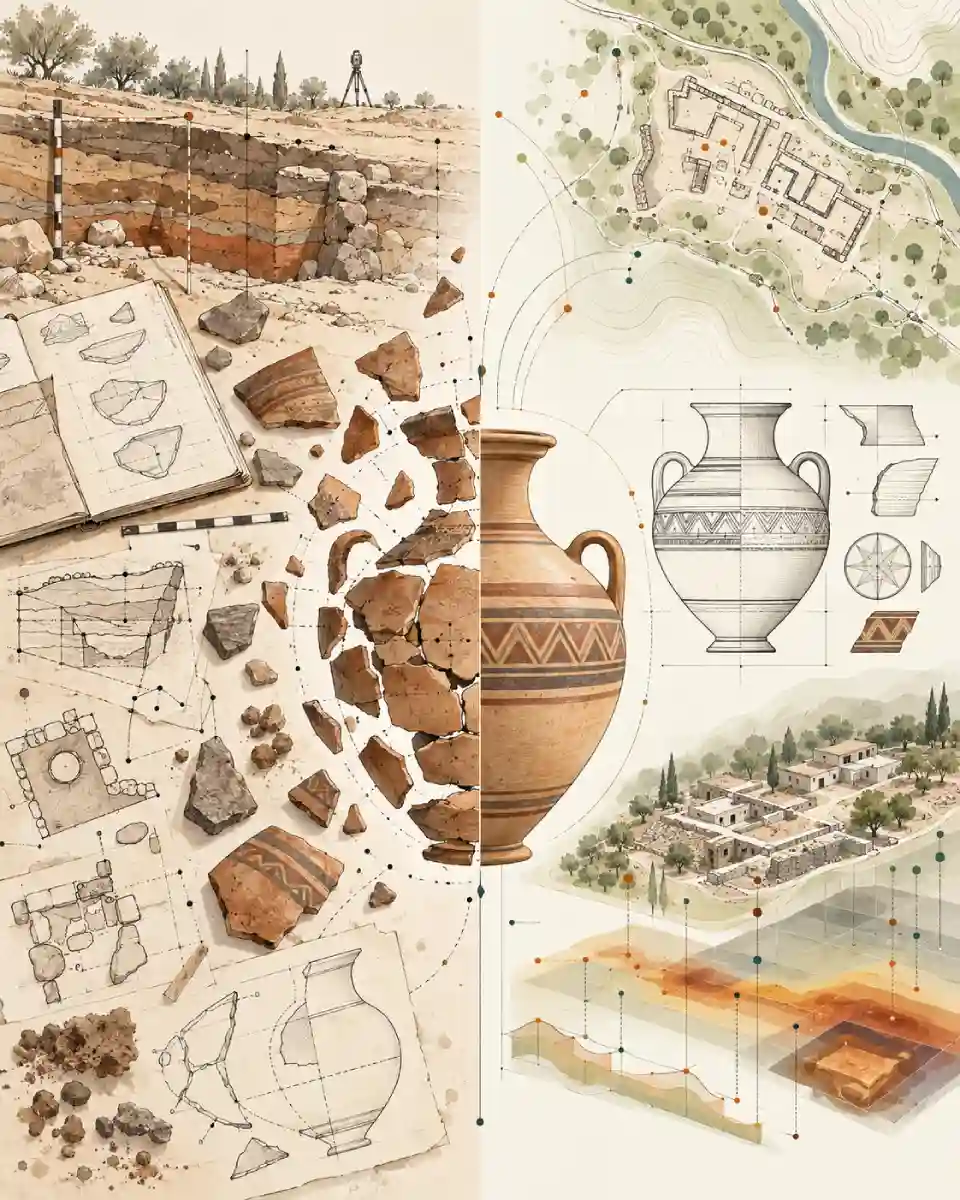
For this publication, data visualization is understood in its broadest sense: any process through which archaeological evidence, data, hypotheses, uncertainties or interpretations are translated into forms that can be perceived, explored, questioned and shared.
These forms may be scientific or technical—maps, diagrams, 3D models, reconstructions and digital interfaces—but they may also be illustrative, literary, narrative, performative, theatrical, audiovisual or artistic.
The central question of this special issue is therefore:
What happens to archaeological knowledge when archaeological evidence is translated into another visual, narrative, sensory or performative language?
Such translation may do more than communicate existing results. It may expose inconsistencies, identify gaps, challenge assumptions, reveal methodological biases and generate new archaeological questions.
A fictional narrative, for example, may reveal that an archaeological interpretation does not account for a particular sequence of actions. An illustrator may identify spatial or functional inconsistencies overlooked in a conventional description. Performance may raise questions about gesture, movement and the use of space. A reconstruction may expose how supposedly “neutral” choices of colour, lighting, texture, scale or viewpoint influence interpretation.
In this sense, representation can become part of the research process itself.
We are particularly interested in the process of exchange itself: not what archaeology can provide to artists, designers, writers, performers or specialists from other disciplines, but what their practices, constraints, methods and ways of seeing can contribute to archaeological research.
Contributions discussing limitations, unsuccessful experiments and unexpected results are equally welcome. Innovation is rarely linear, and understanding why an experiment fails may be as productive as presenting a successful application.
Who can contribute?
The call is open to archaeologists, heritage professionals, digital practitioners, designers, architects, scientific illustrators, writers, comic authors, playwrights, actors, directors, visual artists, researchers from other disciplines and other creative practitioners.
Contributions may be submitted by individual researchers or practitioners, as well as by interdisciplinary teams bringing together archaeological and non-archaeological expertise. Case studies are particularly encouraged.
💬 In the same tome, join the discussion and share your examples of how visualization has generated new archaeological knowledge on Academia.edu or our feed on our LinkedIn profile.
Submission guidelines
Please send a paper proposal of no more than 400 words by 20 December, 2026 to: recherche@arkeotopia.org
Proposals should include:
- title of the proposed paper;
- name(s) of the author(s);
- institutional or professional affiliation(s);
- contact email address.
Authors whose proposals are selected will subsequently be invited to submit a full paper of 20,000–40,000 characters, following the editorial guidelines provided for the publication.
Final paper deadline: 15 April 2027.
No Participation Fees
This call for papers requires no funding, as the selected publisher does not charge APCs.
Volume Editors
- Jean-Olivier Gransard-Desmond (Head of research, ArkéoTopia and EAA Political Strategies Community – FR)
- Matthew Walsh (National Museum of Denmark, Modern History & World Cultures and EAA StoryArch community – NL)
Editorial Committee
- Samantha Scott Reiter (National Museum of Denmark, Prehistoric Archaeology – Environmental Archaeology and Materials Science; EAA StoryArch Community — NL
- Dominik Lengyel (BTU Brandenburg University of Technology Cottbus-Senftenberg – DE)
- Peter Kienzle (LVR-Archaeological Park at Xanten – DE)
- Harold Mytum (University of Liverpool – UK)

