contact@arkeotopia.org


Translation by Ch. Angibous-Esnault and J.-O. Gransard-Desmond
Step 2.1 – Locating Archaeological Remains
Study Written Sources
Corresponding pages in MAB1 and MAB2
MAB 1, p. 6 and p. 25 (step 1.3 on p. 7 and p. 25 in 1st edition) and MAB 2, pp. 7-8 and p. 31
More about the step’s reference artifact
The drawing in My Archaeology Book titled Study Written Sources are based on the Iliad and the Odyssey attributed to Homer, an aedic poet of the 8th century BCE, nicknamed “the Poet”.
After the death of the great heroes of both sides, Hector and Achilles, the Trojan War is at a halt because neither side can prevail on the battlefield. Inspired by Athena, Ulysses imagined a ruse to take over the city: to bring into Troy a gigantic wooden horse containing about twenty warriors. It is Epaios, an architect and carpenter, who is in charge of the construction.
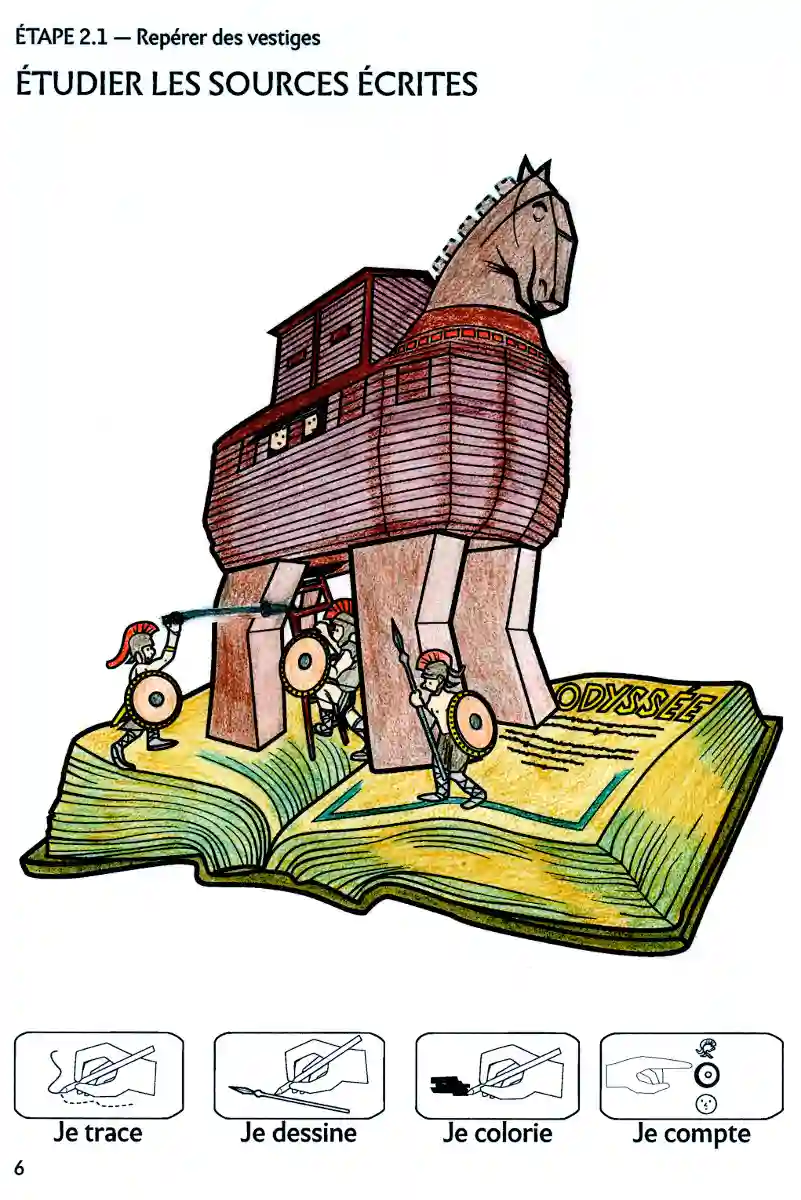
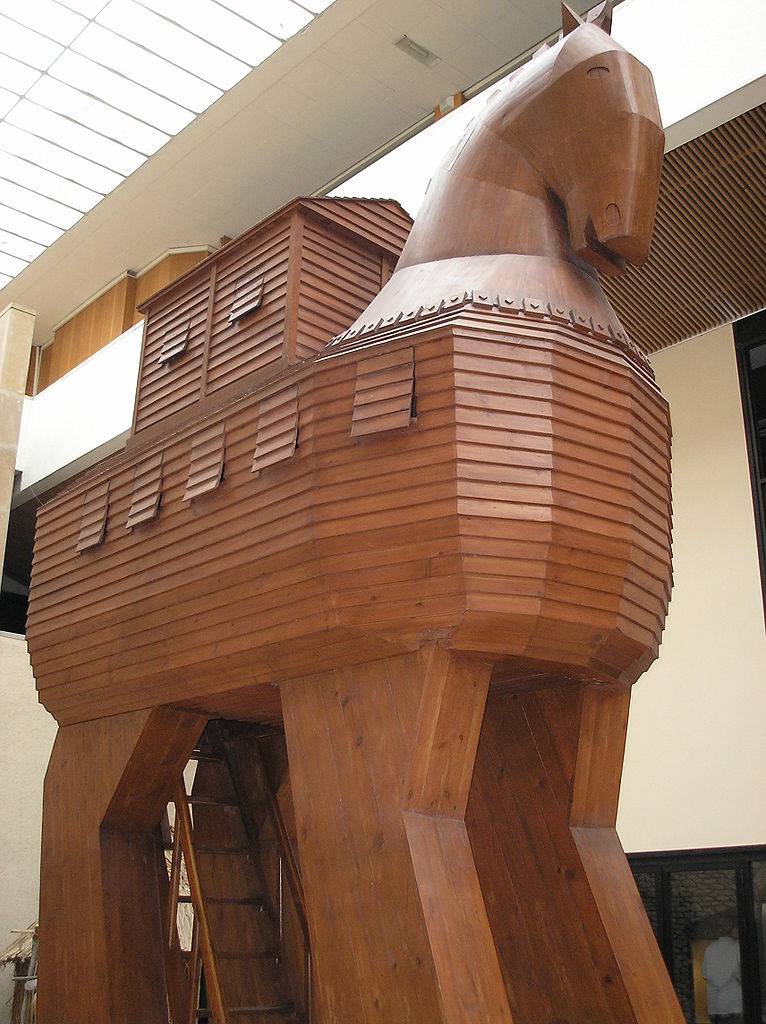
For p. 6, we have chosen the life-size reconstruction of the Trojan horse from the Istanbul Archaeological Museum (image on the left) and for p. 25, we have chosen the representation of the Mykonos pithos (jar), dated to the Archaic period (around 670 CE) and preserved in the Mykonos Archaeological Museum (inv. 2240) in Greece (image on the right).

Clues
The 2 clues include:
- The book as a support for the written source
- The title of the book as a text relating an event
These two clues refer to the idea of identifying a human settlement thanks to written sources, as Heinrich Schliemann did for the site of Troy, which was the subject of numerous archaeological excavations.