contact@arkeotopia.org


Translation by J.-O. Gransard-Desmond and L. Gallet
Step 3 – Seeking Funding for Archaeological Research
Corresponding pages in MAB1 and MAB2
MAB 1, p. 13 (step 2, p. 7 in the 1st edition) and MAB 2, pp. 16-17
More about this step’s reference artifact
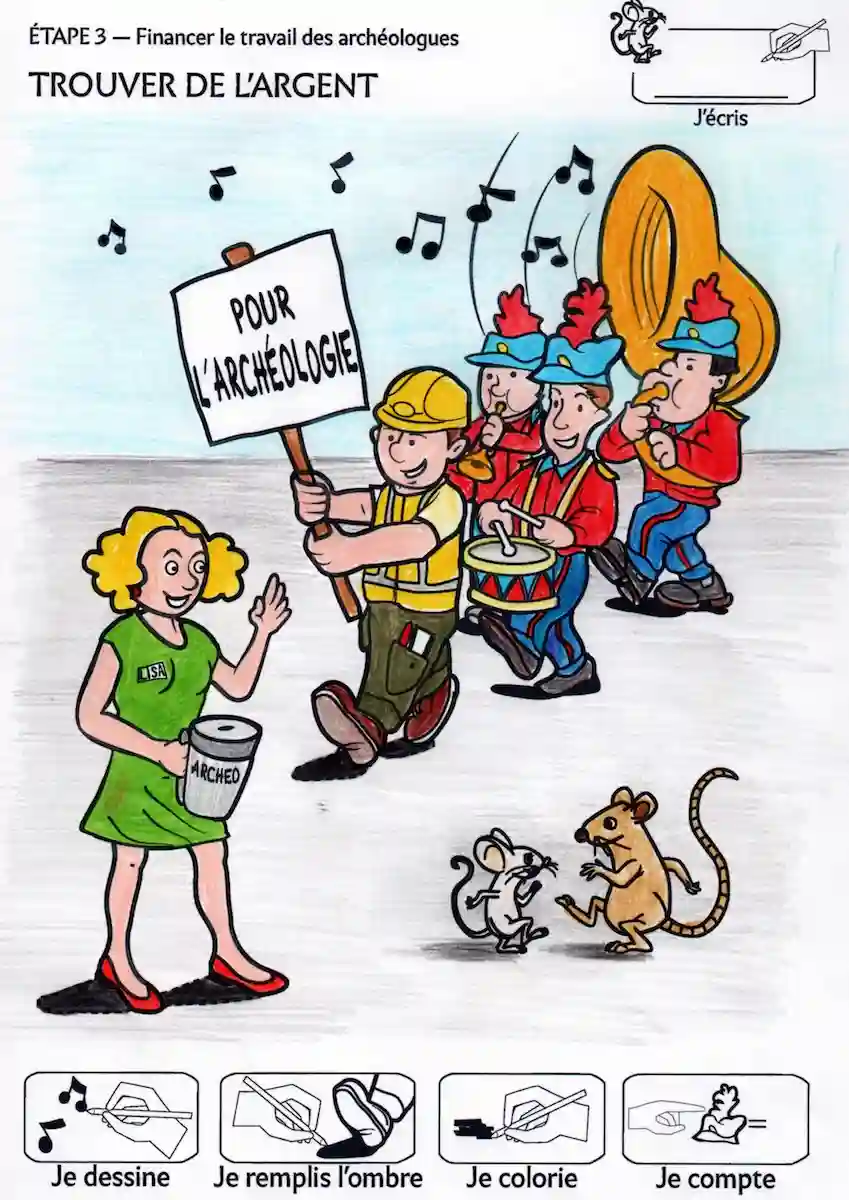
The drawing in My Archaeology Book titled Fundraising shows a parade of supporters campaigning for archaeological research. Whether conducted by professionals or volunteers, fund seeking is a necessary part of what makes archaeological research possible.
Some money is needed in order to finance the steps previously outlined in My Archaeology Book. A full research program, however, including excavation, analyses, and publication, requires even more funds.


In terms of research archaeology, the largest funding source for missions abroad is the research grant for archaeological missions provided by the Ministry for Europe and Foreign Affairs.

Other funding is available through:
- Local and regional authorities (financement des collectivités territoriales) funded using local taxes
- Agencies dedicated to funding research. In France, the main agency for research funding is the Agence Nationale de la Recherche (National Agency for Research).
- Sponsorships from companies, foundations, and associations
- Crowdfunding through several platforms; one of the most well known in France is Dartagnans, dedicated to the preservation of patrimony, art and culture
- And other alternatives like private funds, micro-financing, etc.
Every major step in an archaeological operation (survey, test trench, excavation or experimentation) has its own associated costs and thus requires its own budget. The costs differ depending on the mission. Moreover, every mission also entails data acquisition, analysis and publication, and all of these steps require qualified people and specific equipment.
The average cost of a small excavation is around 56 000 $, not including the cost of data analysis and publication. One archaeological survey cost proposal is thus not surprising, estimating a cost of 15 000 $ (including taxes) for an archaeological testing in 2011.
The drawing for My Archaeology Book does not accurately represent present day practices in fundraising for archaeological research. It does, however, introduce the oft-forgotten notion of project financing in a fun way that highlights its importance in advancing our knowledge of history.
Clues
The 5 clues include:
- The urn to collect money from contributors
- Lisa the archaeologist asking for donations to help fund archaeological research
- Alex at the head of the procession holding a sign reading “Vive l’archéologie” (“long live archaeology”)
- The band, to add a celebratory spirit to the event
- Musculus the mouse and Ratiche the rat dancing